Lean production enables companies to reduce waste while improving product quality, delivery times, and profitability.
Boosting Competitiveness Through Efficiency, Innovation and Smart Production
As production costs continue to rise due to inflation, energy prices, logistics challenges and exchange rate volatility, manufacturers across Ghana and Africa face increasing pressure to remain competitive.
Reducing production costs is no longer simply about cutting expenses—it is about producing smarter, improving efficiency and creating sustainable competitive advantages.
For Ghana's manufacturing sector to play a central role in the country's 24-Hour Economy agenda, businesses must embrace modern production techniques, digital transformation and operational excellence.
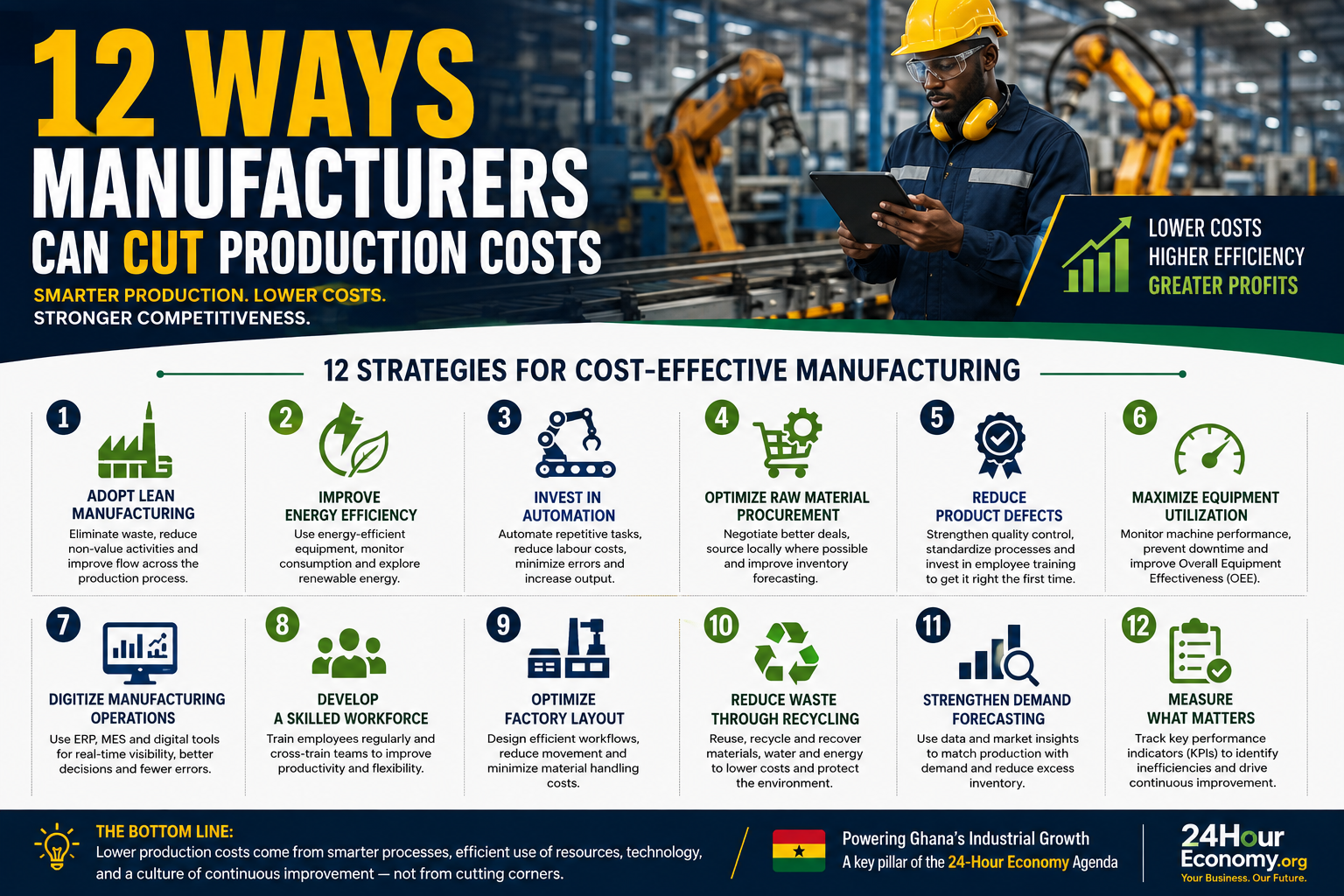
1. Adopt Lean Manufacturing
Lean manufacturing focuses on eliminating activities that do not add value to the customer.
Manufacturers should identify and eliminate:
- Material waste
- Excess inventory
- Machine downtime
- Waiting time between processes
- Unnecessary transportation
- Production defects
- Overproduction
Lean production enables companies to reduce waste while improving product quality, delivery times and profitability. Continuous improvement approaches such as Kaizen and Just-in-Time (JIT) inventory management have helped manufacturers worldwide lower costs while maintaining quality.
2. Improve Energy Efficiency
Energy remains one of the largest operating costs for manufacturers, particularly in countries with high electricity tariffs and fuel prices.
Companies can significantly reduce costs by:
- Installing energy-efficient motors
- Switching to LED factory lighting
- Using variable speed drives
- Monitoring energy consumption in real time
- Scheduling energy-intensive processes during lower-cost periods where feasible
- Investing in solar and hybrid power systems
Studies indicate manufacturers can substantially reduce energy consumption through systematic efficiency improvements, directly lowering production costs.
3. Invest in Automation
Automation is no longer reserved for multinational corporations.
Affordable technologies now include:
- Automated packaging systems
- Robotic palletizers
- Barcode inventory management
- AI-powered quality inspection
- Production monitoring dashboards
- Predictive maintenance systems
Automation reduces:
- Labour costs
- Human error
- Product defects
- Material waste
- Production delays
It also improves consistency and enables higher production volumes with better quality.
4. Optimize Raw Material Procurement
Raw materials often account for the largest share of manufacturing costs.
Manufacturers should:
- Negotiate long-term supplier contracts
- Source quality local inputs where available
- Diversify suppliers to reduce risk
- Consolidate purchases for volume discounts
- Improve inventory forecasting
Digital procurement systems can also reduce purchasing errors and improve supplier relationships. More resilient and diversified supply chains have become increasingly important in response to global disruptions.
5. Reduce Product Defects
Every defective product represents wasted materials, labour, machine time and energy.
Manufacturers should invest in:
- Quality control systems
- Standard operating procedures
- Employee training
- Root cause analysis
- Statistical process control
Improving "first-time-right" production reduces rework and increases customer satisfaction.
6. Maximize Equipment Utilization
Idle machinery is expensive.
Manufacturers should monitor:
- Overall Equipment Effectiveness (OEE)
- Machine downtime
- Maintenance schedules
- Production bottlenecks
Predictive maintenance using sensors and production analytics can detect equipment issues before failures occur, reducing costly interruptions.
7. Digitize Manufacturing Operations
Industry 4.0 technologies allow manufacturers to make better decisions based on real-time data.
Useful digital tools include:
- ERP systems
- Manufacturing Execution Systems (MES)
- Inventory management software
- Digital production scheduling
- Business Intelligence dashboards
Digitalization improves visibility across production, purchasing, finance and logistics while reducing manual errors.
8. Develop a Skilled Workforce
Technology alone cannot deliver efficiency.
Employees should receive regular training in:
- Lean manufacturing
- Machine operation
- Safety
- Preventive maintenance
- Quality management
- Digital tools
Cross-training employees also provides greater flexibility during peak production periods.
9. Optimize Factory Layout
Poor factory design increases production time and material handling costs.
A well-designed production floor should:
- Reduce movement
- Improve workflow
- Minimize transportation
- Increase safety
- Improve productivity
Even small layout improvements can significantly reduce production cycle times.
10. Reduce Waste Through Recycling
Many manufacturing processes generate valuable waste materials that can be reused or sold.
Examples include:
- Plastic recycling
- Metal scrap recovery
- Water recycling
- Heat recovery systems
- Packaging reuse
Circular manufacturing reduces environmental impact while lowering operating costs and recovering value from materials.
11. Strengthen Demand Forecasting
Producing more than market demand ties up capital and increases storage costs.
Modern forecasting tools help manufacturers:
- Match production with demand
- Reduce excess inventory
- Lower warehouse costs
- Improve cash flow
Better forecasting also supports more efficient procurement and production planning.
12. Measure What Matters
Manufacturers should continuously monitor key performance indicators (KPIs), including:
- Cost per unit produced
- Energy cost per unit
- Scrap rate
- Inventory turnover
- Machine utilization
- Labour productivity
- On-time delivery
- Gross profit margin
Regular measurement helps identify inefficiencies early and supports continuous improvement.
Ghana's Opportunity Under the 24-Hour Economy
The Government's 24-Hour Economy initiative presents a significant opportunity for Ghana's manufacturing sector. By extending production hours, increasing factory utilization, and adopting modern technologies, manufacturers can lower fixed costs per unit, improve competitiveness, create more jobs and expand exports.
However, operating around the clock must be supported by reliable electricity, efficient logistics, skilled labour, access to affordable financing and digital production systems.
Businesses that combine these enabling factors with lean manufacturing, automation and strong supply chain management will be best positioned to thrive in both domestic and international markets.
Conclusion
Reducing production costs is not about compromising quality or cutting corners. Sustainable cost reduction comes from eliminating waste, improving efficiency, embracing technology, optimizing supply chains and investing in people.
Manufacturers that adopt these strategies will be better equipped to withstand economic pressures, improve profitability and contribute meaningfully to Ghana's industrial transformation and long-term economic growth.
As Ghana pursues industrialization through the 24-Hour Economy, efficient manufacturing will be a cornerstone of national competitiveness. Companies that invest today in smarter production methods will be the ones leading tomorrow's economy.
 Business Knowledge Centre