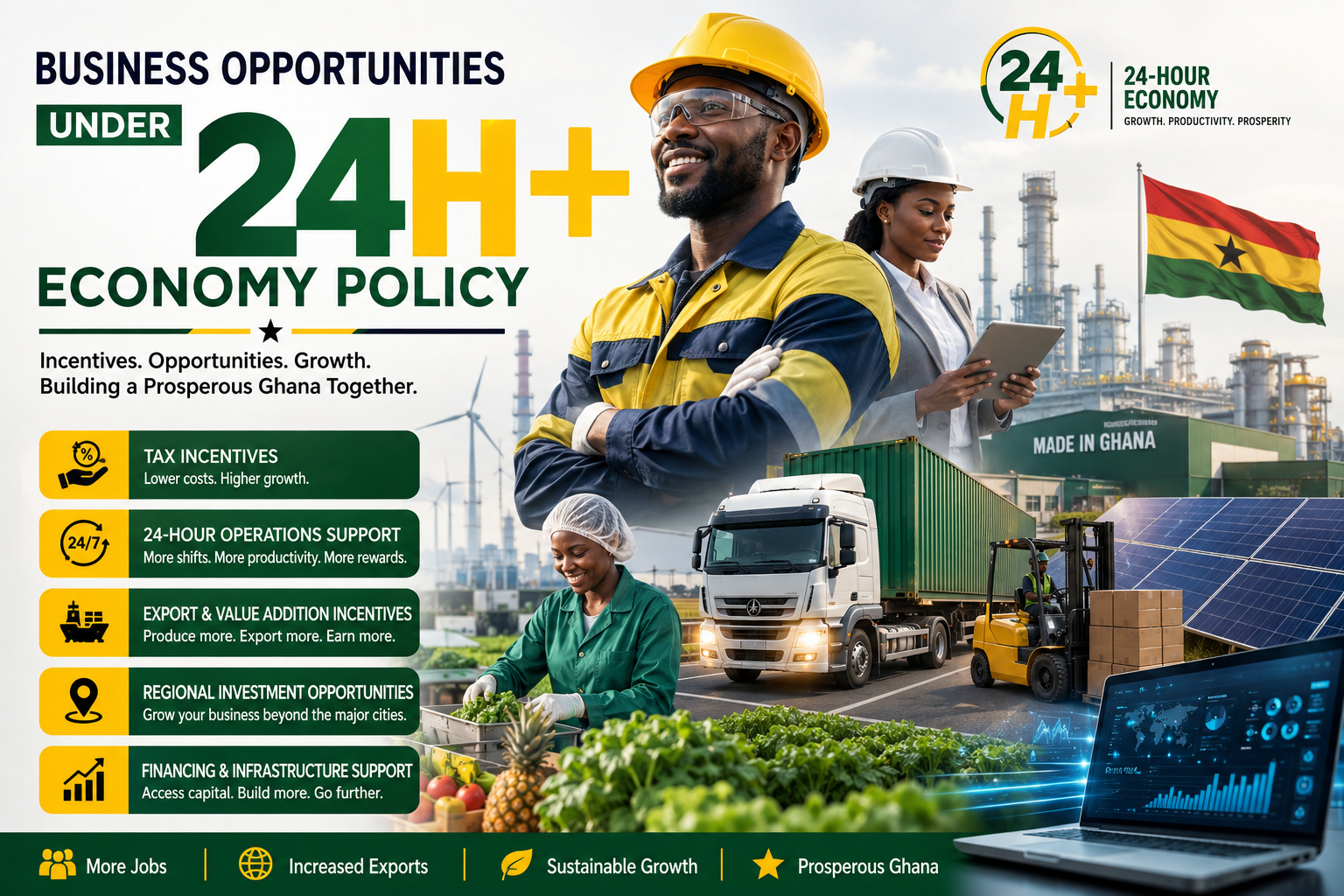
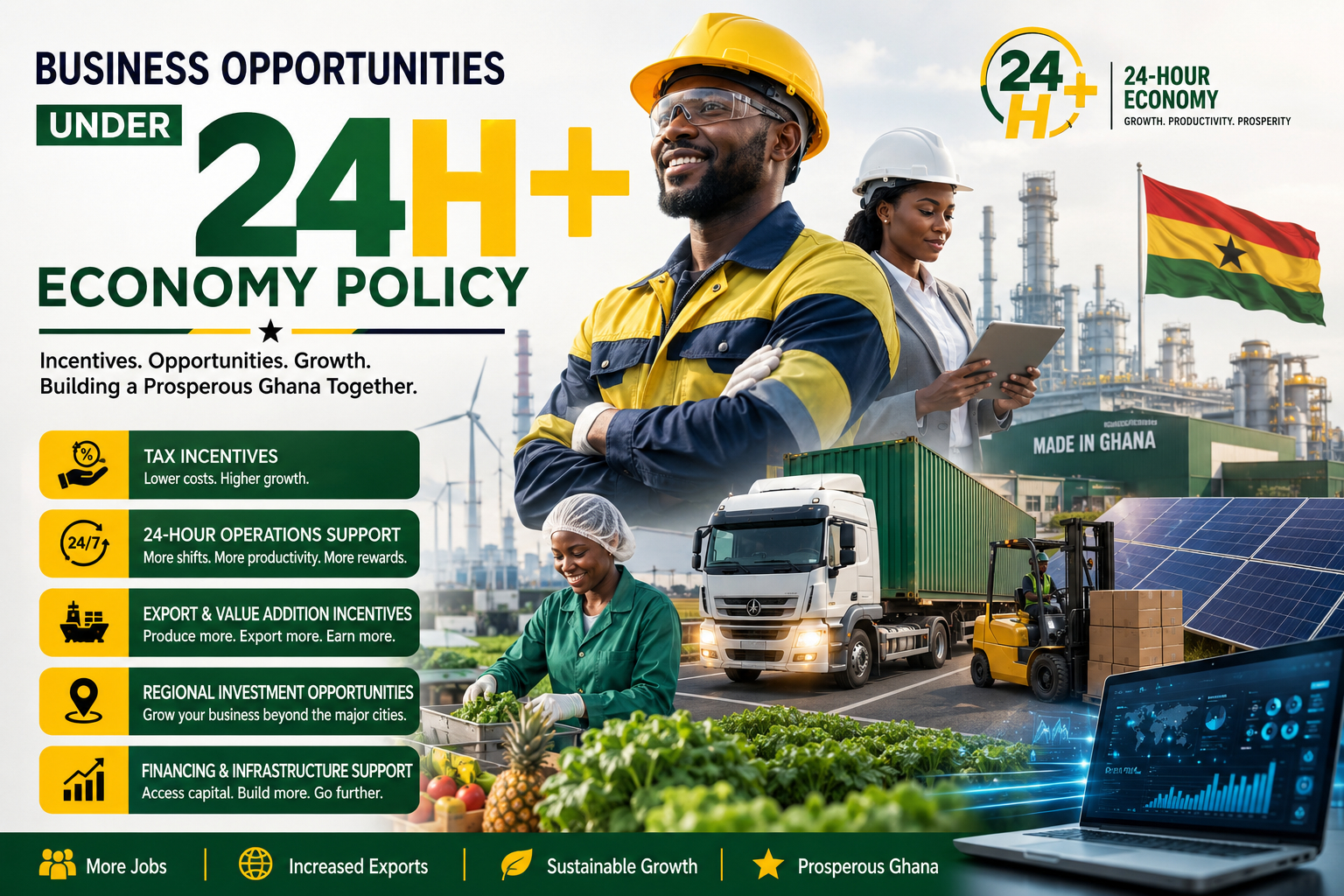
For entrepreneurs, manufacturers, exporters, investors, SMEs, cooperatives, and multinational companies, the policy presents significant opportunities across multiple sectors.
Ghana's 24-Hour Economy and Accelerated Export Development Programme (24H+) is creating a new business environment designed to reward productivity, investment, value addition, exports and job creation.
Rather than offering incentives based solely on industry classification or company status, the policy focuses on businesses that actively contribute to national economic transformation.
For entrepreneurs, manufacturers, exporters, investors, SMEs, cooperatives and multinational companies, the policy presents significant opportunities across multiple sectors.
1. Tax Incentives for Productive Businesses
Businesses that invest in manufacturing, agro-processing, renewable energy, logistics and industrial production may benefit from attractive tax incentives.
Potential opportunities include:
- Import duty exemptions on eligible manufacturing machinery and industrial equipment.
- Tax relief on renewable energy systems and solar equipment used in production.
- Import tax exemptions for approved raw materials not available locally.
- Relief on selected logistics and commercial transport equipment.
- Corporate income tax incentives for strategic agricultural value chains.
- VAT relief for qualifying businesses operating in priority sectors.
These measures are intended to lower the cost of establishing and expanding productive enterprises.
2. Rewards for Operating a 24-Hour Business
One of the flagship features of the policy is encouraging businesses to extend operations beyond the traditional eight-hour working day.
- Businesses operating multiple shifts may qualify for enhanced incentives, including:
- Reduced Corporate Income Tax.
- Priority access to essential utilities such as electricity and water.
- Faster regulatory approvals and government support services.
- Increased competitiveness through continuous production.
Manufacturing companies, logistics operators, hospitals, ICT firms, warehouses, food processing plants, call centres, transport companies, and service providers stand to benefit significantly from round-the-clock operations.
3. Export Expansion Opportunities
The policy encourages Ghanaian businesses to increase exports by rewarding companies that successfully access international markets.
Opportunities include:
- Export rebates linked to export performance.
- Additional incentives for businesses that add value locally before exporting.
- Support for companies using locally sourced raw materials.
- Incentives for research, innovation, and production improvements.
- Reduced equipment costs for export-oriented manufacturers.
This creates a strong business case for producing in Ghana while targeting regional and international markets.
4. Made-in-Ghana Production Support
Businesses committed to producing locally can access a range of financial and operational support.
Possible benefits include:
- Affordable financing.
- Business grants.
- Equipment leasing programmes.
- Support for acquiring machinery.
- Assistance in accessing raw materials.
- Participation in trade fairs, exhibitions, digital marketplaces, and promotional campaigns.
These initiatives are designed to strengthen domestic manufacturing and increase the competitiveness of Ghanaian products.
5. Opportunities for Businesses Outside Major Cities
The policy promotes industrial decentralisation by encouraging businesses to establish operations across different regions of Ghana.
Businesses locating production facilities outside major commercial centres may benefit from:
- Initial tax-free operating periods.
- Location-based tax incentives.
- Lower operating costs.
- Access to emerging regional markets.
- Opportunities to create employment in underserved communities.
This makes regional investment increasingly attractive for manufacturers and agro-processors.
6. Improved Access to Affordable Business Financing
Access to capital remains one of the biggest challenges facing businesses. The 24-Hour Economy policy seeks to improve financing options through strategic development institutions.
- Available opportunities may include:
- Loans at competitive interest rates.
- Long-term investment capital.
- Venture financing for growth-oriented businesses.
- Priority financing for cooperatives and recognised trade associations.
Businesses with scalable projects and strong value chains are expected to benefit most.
7. Infrastructure Investment Opportunities
Private investors who contribute to critical productive infrastructure may qualify for additional incentives.
Areas of opportunity include:
- Industrial parks.
- Feeder roads serving production zones.
- Renewable energy installations.
- Inland logistics facilities.
- Air cargo infrastructure.
- Processing centres supporting exports.
Such investments strengthen both individual businesses and national supply chains.
8. Green Economy and Renewable Energy Businesses
The policy recognises the importance of environmentally sustainable industrial development.
- Business opportunities include:
- Waste-to-energy projects.
- Biomass energy production.
- Bio-fertiliser manufacturing.
- Compost production.
- Animal feed production.
- Renewable energy solutions for industry.
Qualifying businesses may benefit from tax incentives, accelerated approvals, and support for project development.
9. Strategic Manufacturing Value Chains
The government intends to strengthen selected manufacturing industries capable of creating jobs and increasing exports.
Potential growth sectors include:
- Food processing.
- Cosmetics manufacturing.
- Cement production.
- Plastics manufacturing.
- Industrial processing.
- Consumer goods manufacturing.
Businesses operating within these value chains may benefit from targeted financing and export support initiatives.
10. Faster Investor Services
The policy also aims to simplify doing business in Ghana through improved government service delivery.
- Expected improvements include:
- Digital investor registration platforms.
- Faster approvals.
- Dedicated support for strategic investments.
- Better coordination among government agencies.
- Performance tracking and transparent incentive administration.
These reforms are intended to reduce administrative delays and improve the investment experience.
11. Skilled Workforce Development
To support industrial expansion, businesses may benefit from policies that improve access to specialised technical expertise.
Potential advantages include:
- Easier access to skilled expatriate professionals where necessary.
- Support for technical training.
- Skills transfer programmes.
- Development of local workforce capacity.
This is particularly relevant for companies introducing new technologies and advanced manufacturing processes.
12. Cooperative and SME Development
Small businesses, cooperatives, and trade associations remain central to the success of the 24-Hour Economy.
Support measures are expected to include:
- Capacity building.
- Digital transformation programmes.
- Access to affordable financing.
- Institutional strengthening.
- Greater participation in national value chains.
These initiatives provide opportunities for SMEs to scale operations and compete more effectively.
13. Opportunities for Foreign Investors
International investors establishing operations in Ghana may also benefit from the broader incentive framework.
Businesses that invest locally and contribute to national development may enjoy:
- Streamlined investor support services.
- Faster work and residence permit processes.
- Access to investment incentives available under the programme.
- Strong government engagement throughout the investment lifecycle.
In return, investors are expected to:
- Develop local supplier networks.
- Promote technology and knowledge transfer.
- Source inputs locally where feasible.
- Contribute to skills development.
- Support domestic market growth.
Looking Ahead
The 24-Hour Economy policy represents more than an incentive programme. It is a long-term strategy aimed at transforming Ghana into a competitive production, logistics, manufacturing and export hub.
Businesses that invest in productivity, embrace innovation, create quality employment, operate efficiently, and participate in local value chains are likely to be well positioned to benefit as the policy is implemented.
For entrepreneurs and investors, now is an ideal time to evaluate how existing or planned businesses can align with the opportunities emerging under Ghana's 24-Hour Economy agenda.
Editorial Note: Incentives described above are subject to the implementation guidelines, eligibility criteria, and applicable laws issued by the Government of Ghana. Businesses are encouraged to seek professional tax, legal, and investment advice before making investment decisions.
Source: 24H+ Private Sector Incentives - 24hr Economy & Accelerated Export Development
 Policy Updates