For decades, Ghana's vehicle market has been dominated by used vehicle imports. According to figures presented by the GSA, approximately 90 percent of vehicles imported into Ghana are used, while only about 10 percent are new vehicles.
By 24HourBusiness News Desk
Accra, Ghana – Ghana is preparing for one of the most significant reforms in its automotive industry, with the Ghana Standards Authority (GSA) outlining a new regulatory framework that will tighten controls on vehicle imports and establish higher quality standards across the sector.
The proposed reforms signal the end of an era in which almost any used vehicle could enter the Ghanaian market with limited technical oversight. Instead, imported vehicles will increasingly be subject to conformity assessments, inspections and certification processes designed to improve road safety, environmental protection and consumer confidence.
The announcement formed part of a presentation by the GSA outlining its vision for transforming Ghana's automotive industry into a modern, standards-driven ecosystem.
A New Direction for Ghana's Automotive Industry
For decades, Ghana's vehicle market has been dominated by used vehicle imports. According to figures presented by the GSA, approximately 90 percent of vehicles imported into Ghana are used, while only about 10 percent are new vehicles. The Authority believes this trend has contributed to safety concerns, environmental challenges and inconsistent vehicle quality.
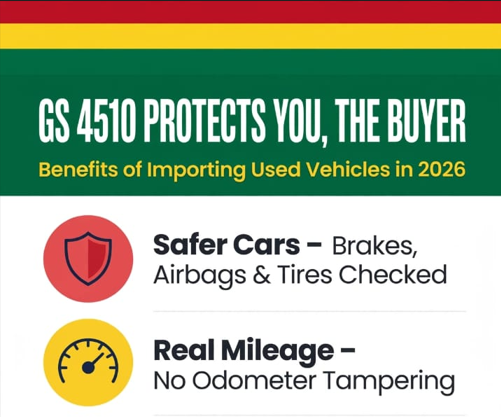
Under the proposed framework, imported vehicles will increasingly be required to meet internationally recognised standards before entering the Ghanaian market.
Stronger Inspection and Certification
The reforms introduce a more comprehensive conformity assessment process for imported vehicles.
The GSA proposes that new vehicles undergo testing, inspection and homologation, while used vehicles will require pre-shipment inspections, certificates of conformity and destination verification before they can be cleared for entry into Ghana.
The measures are intended to prevent the importation of accident-damaged, flood-damaged, fire-damaged and other substandard vehicles.
A Complete Automotive Ecosystem
Beyond regulating imports, the GSA's vision extends across the entire automotive value chain.
The proposed framework covers:
- Vehicle manufacturing
- Vehicle assembly
- Importation and distribution
- Spare parts
- Garages and maintenance
- Vehicle financing
- Motor insurance
- Vehicle software
- Electric vehicles
- Recycling and end-of-life vehicle management
The presentation highlights the need for closer collaboration between regulators, industry players and technology providers to build a competitive automotive sector capable of supporting Ghana's industrialisation agenda.
Electric Vehicles Receive Major Attention
One of the most forward-looking aspects of the presentation is Ghana's preparation for electric mobility.
The GSA disclosed that it has already developed 49 standards for electric vehicle charging infrastructure and 51 standards relating to electric vehicles, laying the regulatory foundation for future EV adoption in Ghana.
Business Impact
The reforms are expected to reshape the automotive industry.
Vehicle importers may face additional compliance requirements and documentation costs, while dealers offering high-quality vehicles are likely to benefit from increased consumer confidence.
Certified garages, genuine spare parts distributors and vehicle inspection companies could also see increased demand as compliance becomes more important throughout the industry.
Banks and insurance companies may equally benefit from improved vehicle quality, enabling more accurate risk assessment and financing decisions.
Opportunities for Local Businesses
The proposed reforms also create opportunities for Ghanaian technology companies and service providers.
Businesses involved in digital certification, inspection management systems, vehicle tracking, artificial intelligence, conformity assessment and automotive software development could play an increasingly important role as the new regulatory framework is implemented.
Industry observers believe companies capable of supporting digital compliance and certification processes will be well positioned as Ghana modernises its automotive sector.
While implementation timelines have yet to be announced, the GSA's presentation clearly signals that Ghana is moving towards a more regulated, transparent and standards-driven automotive industry, fundamentally changing how vehicles are imported, certified and sold in the country.

 Policy Updates